We re-examine education and physics as tools for actual community organizing, building, and communal problem solving
The Institute's Rooms
Oct 9, 2015
Dialectical Communitarian Anarchism as the Negation of Domination: A Review of "The Impossible Community"
Aug 15, 2015
The Emergence of Eco-decentralism
Mumford Gutkind Bookchin:
The Emergence of Eco-decentralism
by
Janet Biehl http://www.biehlonbookchin.com/books/
| http://www.biehlonbookchin.com |
In
the 1950s the aging Rose Bookchin still lived in the old apartment in East
Tremont, the Bronx neighborhood where she and her family had lived since 1920
and where her son Murray had grown up. Rose had been a diabetic for two decades
and was nearly blind. She was incapable of giving herself daily insulin
injections, so every day Murray took the Third Avenue El to East Tremont to
administer them.
He
would step onto the platform, and if he looked to the south, he could see over
the tops of the buildings the trees of Crotona Park. Then down the stairs and
onto the sidewalk, and he stroke briskly past his old street-side haunts: the
kosher butcher, the deli with pickles and whitefish and knishes, the old candy
store, the dairy with its slabs of butter — the old familiar shops were still
there. Most of the kids he’d known in YCL had moved away too, but their parents
still lived here — the buildings were rent controlled, after all, and it suited
them fine. The vacancy rate in East Tremont was less than one percent. Snatches
of Yiddish in the streets came to his ears, as in the old days, a comforting
sound as always. One difference: the farmers from New Jersey who’d brought
their produce over the bridge into the Bronx — they didn’t come here anymore.
Their farmlands were paved over. No one was farming there or in Yonkers now.
Jul 9, 2015
What is Zadruga Urbana?
“Zadruga Urbana” is a group of people who came
together with the shared dissatisfaction for the current system of food
production, who believe in the necessity for a collective movement to
take the process into their own hands. We believe that collective
gardens raise people’s awareness of producing their own food, consuming
locally and being autonomous/productive, enabling individuals without
land of their own to produce food with a sensitivity for their local
natural environment.
Our group wants to bring people together to learn and promote the
ideas to find solutions for change towards a more sustainable life
regardless of previous experience. Everyone is welcome to participate in
our gardens and network, to learn and share the skills of producing our
own food. We aim to use local seeds and to fertilize our crop
naturally.
Apr 19, 2015
Back in action with mycology in a permacultured community
If one can follow in detail some very careful steps in starting up mushroom growing especially on a farm and even more so on a farm with permaculture as part of its design, you can feed a whole bunch of people using what you may otherwise throw away. While growing mushrooms the left overs from the production become some of the best compost and soil producer on earth. It may be a science to know too much but you may regulate how much and what you need to know.
We encountered a great set of videos that are the best introduction to general mushroom knowledge based on a community/collective farm in New Hampshire called D-Acres dacres.org which is among the best community projects we have encountered in this English speaking universe. We hope you find the videos informative and get you started on something
https://youtu.be/y8sm1uDPWj8
Nov 22, 2014
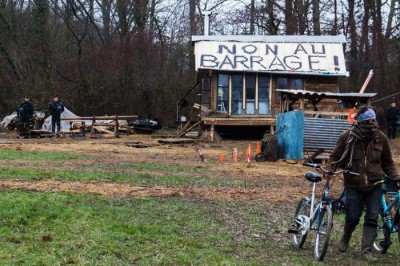
ZAD: Anyone can take part or not take part in a struggle against a dam
And now, what can we do?
Sunday 2 November 2014, by zadist
All the versions of this article:
[English]
[français]
Saturday night, at the construction site of the
dam project in Sivens, at around 2am, Remi died. For those that were
there over the last 6 months at Testet, for those who were in the
battles of at the ZAD at Notre Dame Des Landes, for those who at one
time or another have found themselves face to face with a line of cops,
one thing is obvious, this was neither an error nor a suspicious death,
here we are talking about an assassination.
Saturday night Remi died after a long day of confrontations. The day
before the opponents of the project made the guards leave the site and
managed regain ground by destroying what still remained on the site by
setting it on fire. The next day the anti riot unit of the gendarmerie
returned to the site to protect what is now an empty parking lot. At 2am
that night the death of Remi was announced by medics. Despite this the
police continued to shoot at the protestors until the early morning.
Nov 2, 2014
Rémi killed in clashes with police at the ZAD of Testet
In solidarity to the heroic struggle of ZADists in Nantes and Testet to defend land and its sustainable use against the imperialistic capital and its puppet state of France, and to prevent further social and environmental disaster to spread, we selected this article as a sample of reporting from self-organized counterinformation in English. We wish we could follow the events but our availability of French speakers and translators is very limited.Rémi lives among all of us who will continue to struggle neglecting all the violence, terrorism, and ruthlessness that state repressive mechanisms utilize to break up any form of social resistance develops against their destructive plans.
France: October 27th, 2014
Background info on the struggle against the dam in Testet: 1, 2
According to a statement from squatters in the ZAD of Notre-Dame-des-Landes,
during the night between Saturday and Sunday the 26th of October 2014 a
protester named Remi was killed in clashes that broke out after a rally
against the construction of a dam along the Sivens forest in the
wetland of Testet in the Tarn department (southern France).France: October 27th, 2014
Background info on the struggle against the dam in Testet: 1, 2
Aug 27, 2014
Current events and the state of the world
It has been a very sad August when we allow the media to affect us. Thousands of people dying unnecessarily, in war and conflict, in protests and on the streets, from Missouri to Gaza, from Kurdistan to Damascus, from Donetsk to Santiago, armies, states, police, brutally slaughter their perceived enemies. In Syria the latest count of deaths since the uprising begun has reached 170,000 people and with the ISIS the numbers are climbing. In Gaza 2,100 is the last count in a few weeks. In Ukraine it is questionable what the numbers are but lately different sides refer to 2,000. In Africa the numbers are never so important to the western media to report, until the Ebola epidemic came and the media took an interest as far as this epidemic may cause a threat elsewhere. Yet there is one constant statistic that not many are reporting in the mass media. Over 60,000 people a day, nearly half being children, are dying from the simple cause of the lack of nutrients and clean water. Meanwhile if one is to divide the annual world production of corn (alone) by the population one will find the corn produced alone can prevent death from hunger. An enormous amount of food is produced worldwide, maybe "too much" according to economists who are waged by corporations that benefit from the rise of the price of commodities.
Jul 27, 2014
Natural Building Materials and Biomass Roofing
Sustainable Build of UK is a great source for construction material and techniques that advance the concept of autonomy and sustainability. This post serves as an example of the great information one may find there directly, instead of us borrowing this information. Hopefully it will remain available for time to come, but if you have any plans of using this information soon on a project it is advised to store and reproduce such information as we can not conclude it will always be available and free.
Natural
Building Materials and Biomass Roofing
The Different Types of Biomass Roofing
Although
hundreds of different plants have been used to roof houses, these can be
classified into two main types: thatch and wood tiles.
Jul 26, 2014
Crisis of Humanity and the Specter of 21st Century Fascism
http://www.soc.ucsb.edu/faculty/robinson/Assets/pdf/Crisis%20of%20Humanity.pdf
World Economy www.worldfinancialreview.com May - June 2014 Pg 14 – 16
Global Capitalism:
Crisis of Humanity and the Specter of 21st Century Fascism
By William I.
Robinson
About
the Author
William
I. Robinson is
professor of sociology, global and international studies, and Latin American
studies, at the University of California - Santa Barbara. Among his many books
are Promoting Polyarchy (1996), Transnational Conflicts (2003), A Theory of
Global Capitalism (2004), Latin America
and Global Capitalism(2008), and Global Capitalism and the Crisis of Humanity
(2014).
World capitalism is
experiencing the worst crisis in its 500 year history. Global capitalism is a
qualitatively new stage in the open ended evolution of capitalism characterised
by the rise of transnational capital, a transnational capitalist class, and a
transnational state. Below, William I. Robinson argues that the global crisis
is structural and threatens to become systemic, raising the specter of collapse
and a global police state in the face of ecological holocaust, concentration of
the means of violence, displacement of billions, limits to extensive expansion
and crises of state legitimacy, and suggests that a massive redistribution of
wealth and power downward to the poor majority of humanity is the only viable
solution.
The New Global
Capitalism and the 21st Century Crisis
The
world capitalist system is arguably experiencing the worst crisis in its 500
year history. World capitalism has experienced a profound restructuring through
globalisation over the past few decades and has been transformed in ways that
make it fundamentally distinct from its earlier incarnations. Similarly, the
current crisis exhibits features that set it apart from earlier crises of the
system and raise the stakes for humanity. If we are to avert disastrous
outcomes we must understand both the nature of the new global capitalism and
the nature of its crisis. Analysis of capitalist globalisation provides a
template for probing a wide range of social, political, cultural and
ideological processes in this 21st century. Following Marx, we want to focus on
the internal dynamics of capitalism to understand crisis. And following the
global capitalism perspective, we want to see how capitalism has qualitatively
evolved in recent decades.
Jul 16, 2014
What is the Landless Workers Movement, Movimento dos Trabalhadores Rurais Sem Terra (MST)
A documentary about the history of the fight of the rural workers in Brazil. Go here for the list of videos
Brazil’s Landless Workers Movement, Movimento dos Trabalhadores Rurais Sem Terra (MST) in Portuguese, is
a mass social movement, formed by rural workers and by all those who
want to fight for land reform and against injustice and social
inequality in rural areas.
The MST was born through a process of occupying latifundios (large
landed estates) and become a national movement in 1984. Over more than
two decades , the movement has led more than 2,500 land occupations,
with about 370,000 families - families that today settled on 7.5 million
hectares of land that they won as a result of the occupations. Through
their organizing, these families continue to push for schools, credit
for agricultural production and cooperatives, and access to health care.
Currently, there are approximately 900 encampment holding 150,000
landless families in Brazil. Those camped, as well as those already
settled, remain mobilized, ready to exercise their full citizenship, by
fighting for the realization of their political, social economic,
environmental and cultural rights.
Jul 8, 2014
Why is there a lag in our publishing activity
First, and not least, we do not get paid or receive any money from doing this, nor did we undermine the project as something quick and simple. Certainly we would be able to do more if there were more of us doing it, so if you have developed an interest in getting involved let us know. Sometime horizontal organization is slow and complicated in terms of production. Each one of us must convince and be convinced of a proposal to do something. And this we do neither consider a luxury of a problem, quite the opposite we are critical of those who operate under a hierarchy, an authority, and produce.
Judging by certain polemics it would seem that there are anarchists who spurn any form of organisation; but in fact the many, too many, discussions on this subject, even when obscured by questions of language or poisoned by personal issues, are concerned with the means and not the actual principle of organisation. Thus it happens that when those comrades who sound the most hostile to organisation want to really do something they organise just like the rest of us and often more effectively. The problem, I repeat, is entirely one of means.
Errico Malatesta October 1927
So it is not only important to us to do something or do it quickly, but to find the acceptable ways to do it. If we were to develop specialists, hierarchy, authority, to do something, the value of the product would be all lost as we have returned to the state of affairs we are so eager in departing. So among the other, real life projects we are engaged in, our digital project has fallen back in priority, while we are constantly reexamining what we have done so far and where we want to go with this. And this must take time.
May 12, 2014
our efforts are for peace, their efforts are for war
How can we express enough solidarity and who are we to voice such a thing? How can we ever mention the struggle of the indigenous people of Mexico and not broadcast the following text loud and clear? How can we stand still and read, learn, think, and discuss, when order is threatened by the forces of human disorder and suffering? Rage? No words can ever describe what we feel. We feel as we are in prison, locked far away from our comrades. Locked up in a world without autonomy, without daily dignity for the land we step on, the food the masters feed us, the lies they serve us, the labor extortion they subject us, the humiliation of being trapped and powerless on their land. The submission to a world where they decide and we materialize and execute their wishes, unable to ever materialize any of our own.
Solidarity is a simple word used by many, but few are able to carry on the weight of its true meaning. How can you express solidarity without sharing the struggle? How can you not express solidarity without sharing the defeat from it? And what is there to do? Are we consciously ready to make the leap? Are we ready to leave the world of the masters and create our own world? Are we afraid? Do we have second thoughts? Is there life away from struggle? Is there any meaning in such other life?
Long live the struggle of compañero Galeano
Long live the meeting (the Sixth) of all struggles around the world
May 12, 2014
Where Has It Brought You?
Zapatista Pain and Rage
by SUBCOMANDANTE MARCOS
To the Compañeras and Compañeros of the Sixth:
Compas:
To tell you the truth, the communiqué was all ready. It was succinct, clear, precise, how communiqués should be. But…well…maybe later.
For now the meeting with the compañeros and compañeras bases of support of the community of La Realidad is about to begin.
We listen.
We have known the tone and the emotion with which they speak for a long time: pain and rage.
So it occurs to me that a communiqué will not adequately reflect this.
Or at least not fully.
True, maybe a letter won’t do so either, but at least the words that follow are an attempt, even if they are only a pale reflection.
Because…
Compas:
To tell you the truth, the communiqué was all ready. It was succinct, clear, precise, how communiqués should be. But…well…maybe later.
For now the meeting with the compañeros and compañeras bases of support of the community of La Realidad is about to begin.
We listen.
We have known the tone and the emotion with which they speak for a long time: pain and rage.
So it occurs to me that a communiqué will not adequately reflect this.
Or at least not fully.
True, maybe a letter won’t do so either, but at least the words that follow are an attempt, even if they are only a pale reflection.
Because…
May 9, 2014
Editorial. Rebeldía Zapatista (Zapatista Rebellion)
the Word of the EZLN
![]() |
| Front Cover of Rebeldía Zapatista #2 |
They want to own everything.
They are destructive, they are murderers, criminals, rapists. They
are cruel and inhuman, they torture and disappear people, and they are
corrupt. They are every bad thing you can imagine, they do not care
about humanity. They are, in fact, inhuman.
They are few, but they decide everything about how they will dominate
countries that let themselves be dominated. They have made
underdeveloped countries into their plantations, and made the
underdeveloped capitalist so-called governments of those countries into
their overseers.
This is what has happened in Mexico. The neoliberal transnational
corporations are the bosses, their plantation is called Mexico, the
current overseer is named Enrique Peña Nieto, the administrators are
Manuel Velasco in Chiapas and the other so-called state governors, and
the badly named municipal “presidents” are the foremen.
This is why we rose up against this system at dawn on January 1, 1994.
May 6, 2014
Hannah Arendt on the Concept of Power
My first and only personal encounter with Hannah Arendt was when she came to speak to the students at Yale University in 1968 while I was studying sociology there. As always, she was questioning the conventional wisdom of the times. At that time -- at the height of the Vietnam War crisis -- she stood solidly with the student protesters. Nevertheless, during that visit she sounded a warning against the popular obsession with unlimited "sovereignty" of either the individual or the collective, and with violence as a favored vehicle for both entities in their pursuit of social change. She let us know how much she deplored the glorification of violence by many students, and their glib talk -- from privileged and protected enclaves in the Western world -- of the "necessity" for violent revolution. For this she blamed what she saw as the malevolent influence of Jean-Paul Sartre and Franz Fanon. She felt (rightly, I now believe) that these writers and other significant opinion setters among the young were then sowing the seeds for which the whole world would one day reap the whirlwind.
On power and violence
This
was a book summary we found on
http://www.fsmitha.com/review/arendt.html and we believe it is a good
starting point on the discussion of how social organization leads to
power, from coexistence with other powers will come conflict, and how
can conflict be managed so power is not lost at the stage where
coexistence of powers is impossible. Also under what conditions can
there be no conflicting powers and therefore avoidance of conflict and
violence. Could comments here start an open and public discussion? In
political circles this subject is systematically overseen and avoided.
______________________________________________________________
On Violence
Author: Hannah Arendt
A Harvest Book, 1970
In Arendt's own words:The end of human action, as distinct from the end products of fabrication, can never be reliably predicted. The means used to achieve political goals are more often than not of greater relevance to the future world than the intended goals.
There are, indeed, few things that are more frightening than the steadily increasing prestige of scientifically minded brain trusters in the councils of government during the last decades [the 1950s and '60s] ... they reckon with the consequences of certain hypothetically assumed constellations without, however, being able to test their hypotheses against actual occurrences.
May 5, 2014
Mining, the destruction of land by neo-colonialists
AGAINST THE IMPERIALISM AND NEOCOLONIALISM OF MINING COMPANIES, THE CURRENT BATTLE OF THE PEOPLES
** Organization is required to win, NGO’s from several countries point out in Puebla
** Emissaries from Mexico, Panama, Guatemala, Honduras and El Salvador expose abuses of transnationals
By: Rosa Rojas
Tlamanca, Puebla, March 15, 2014
The struggle against extractive mining “it’s not only for our life,
but also an anti-imperialist struggle and against neo-colonialism that
is imposed on the peoples with the servile attitude of the neoliberal
governments and the agreements on free trade and on protection for
foreign investment,” according to what was made clear here today after
the exposure of particular cases of problems with mining companies that
communities from different states of the country confront, as well as
those in Panama, Guatemala, Honduras and El Salvador.
May 1, 2014
What about music as a form of collective entertainment
Music, the art that has survived capitalism and springs up from every part of the earth and every moment that humans have occupied, continues to express societies, classes, nations, genders, metaphysical beliefs, problems, emotions, happiness and pain. It should not be left on the hands of experts, industries, interests, or government to dictate, to suppress or promote. As a tool, as most arts, crafts, and techniques, should be redistributed to all those below as users and not passive consumers. Everyone can learn music, sing, play an instrument. To do it well takes practice first and a little bit of talent, which we are not convinced of what it really is.
Music has also played a role in popular movements. There has never been any significant social change without some music associated with the movement that caused it, while music for the sake of producing more music has not lived as long, as the music of social history. We found a good introduction to a music genre that survived some real sever oppression to follow basic steps of emancipation and struggle to freedom. The struggle, the living conditions of the past, the pain and suffering of those who sang their way on the narrow path towards liberation, is embedded in their songs.
We Borrowed this From the Music Room
This Primer is dedicated to promoting Rhythm and Blues, but it's clear to anyone with a passing interest in the music that it really doesn't stick to any clear definition of the genre.
Music has also played a role in popular movements. There has never been any significant social change without some music associated with the movement that caused it, while music for the sake of producing more music has not lived as long, as the music of social history. We found a good introduction to a music genre that survived some real sever oppression to follow basic steps of emancipation and struggle to freedom. The struggle, the living conditions of the past, the pain and suffering of those who sang their way on the narrow path towards liberation, is embedded in their songs.
We Borrowed this From the Music Room
This Primer is dedicated to promoting Rhythm and Blues, but it's clear to anyone with a passing interest in the music that it really doesn't stick to any clear definition of the genre.
| John Lee Hooker |
As a Primer, it's an attempt to illustrate the music, the labels and the artists of a particular style but it cannot lay claim to be a theoretical, academic or scholarly treatise. This is primarily because I am ill-equipped to do it well and there are others who are far better qualified to deliver a definitive history of the form.
So what you'll find below is an emotional and historically flawed account of the music that the Primer promotes, designed to provide a background and context for what you'll find in the real world..
Apr 25, 2014
Mushrooms, how much we don't know
If the study of mushrooms is a science in itself it may be the youngest science yet. There is such a vast amount to study around mushrooms that indeed we (humans) may be just barely scratching the surface of this science. As there is very little knowledge around the subject in-house we thought it would be a good excuse to utilize this opportunity to share this learning experience with others who may find an interest. The process of learning something collectively without the assistance of experts is slightly different and it may be even more objective when a wide spectrum of information as a library is available. When information does not exist the process becomes science in its true basis.
Apr 21, 2014
The rights of Zapatista women
There can never and will never be any real social change without women equally participating in this change. The zapatistas (men and women equally and from below) have done precisely this.
From Latin American Press
Orsetta Bellani
4/10/2014
Womens Revolutionary Law provides for access to political and military posts, fair wages, education, health, freedom from abuse and free choice of couples.
Fabiana wakes every morning at 4:30 a.m., like all the women in her community. She grinds the corn she boiled the night before until it becomes soft dough, from which she forms a few balls that once flattened and cooked on a griddle become tortillas. Fabiana, who is ethnically Tzotzil Maya, is 23 years old, with a husband and two children, and also a member of the support base for the Zapatista Army of National Liberation (EZLN).
She works at home almost all day, every day, while toting her youngest child. Her husband helps with some chores traditionally considered “women’s work,” like shelling corn or plucking poultry, and sometimes he takes care of the children while she cooks.
Apr 13, 2014
Agriculturists or People Without Land
Agriculturists Without Land
The following is a critique of the content of the above article and aims to open a discussion on the issue of social movements being incorporated within the system when they can not be defeated by physical (violent repression) means. Comments related to the subject are welcome and will be published as soon as possible.
MST is a 30 year old movement in Brazil. It has both class and social characteristics. It is a movement for people without land by the people without land. Brazil is the country with the largest percentage of the population having no access to land. Very counter-intuitive if you consider the vast area of jungle and unexplored forests created by the Amazon. This means that a very small group of people have converted all land to private status. This was done with a mechanism called IMF when the country first started going bankrupt 40 years ago.
This article nevertheless calls the MST movement agriculturists without land, which apart from being poorly written reveals a specific political value. What we can conclude from it is that land is perceived as means of production which utilizes specialized workers to produce for others. Something that as far as we can find about MST it is not. What is odd about the article and drew our attention is the term agriculturists, meaning agricultural workers, which if searched through the net it has not been used before in reference to MST.
Subscribe to:
Comments (Atom)


.png)